

How Satellite Constellations Coordinate Low-Earth Orbit Telemetry
The Orbital Routing Challenge in Megaconstellation Networks
Low Earth Orbit constellations operate in an environment where network geometry changes continuously. Satellites travel at orbital velocities exceeding 7.5 km/s, and the relative motion between spacecraft, ground terminals, and neighboring orbital planes produces rapidly changing link distances, Doppler conditions, visibility windows, and interference relationships. A route that is optimal seconds earlier may no longer be available when a packet reaches the next node. This is not simply a conventional IP networking problem with faster-moving endpoints. It is a coupled orbital, RF, optical, timing, and flight-computing problem.
Sustained multi-gigabit telemetry therefore requires deterministic coordination rather than routing that reacts only after links degrade. The network must predict contacts from ephemeris data, reserve capacity for command and health traffic, compensate frequency and timing errors in real time, and execute handoffs before the current path disappears. At the physical layer, this requirement is driving convergence between electronically steered RF phased arrays and coherent optical communication systems. RF remains valuable for robust acquisition, control, and atmospheric links, while optical cross-links provide narrow beams, high spatial reuse, and large data capacity between spacecraft.
Physical Layer Trade-offs Between Phased Arrays and Optical Inter-Satellite Links
RF phased arrays provide operational flexibility because electronic beam steering can redirect energy without moving mechanical hardware. A terminal can form multiple beams, support multi-user beamforming, and maintain links across changing look angles. That flexibility is especially useful for gateway connectivity and spacecraft command paths, where acquisition robustness and coverage can matter more than peak throughput. However, the antenna aperture, transceiver count, calibration network, power amplifiers, thermal interface, and digital beamforming hardware all contribute to size, weight, power, and cost. In Ku and Ka bands, high effective isotropic radiated power can also impose demanding thermal constraints, particularly when several beams transmit simultaneously.
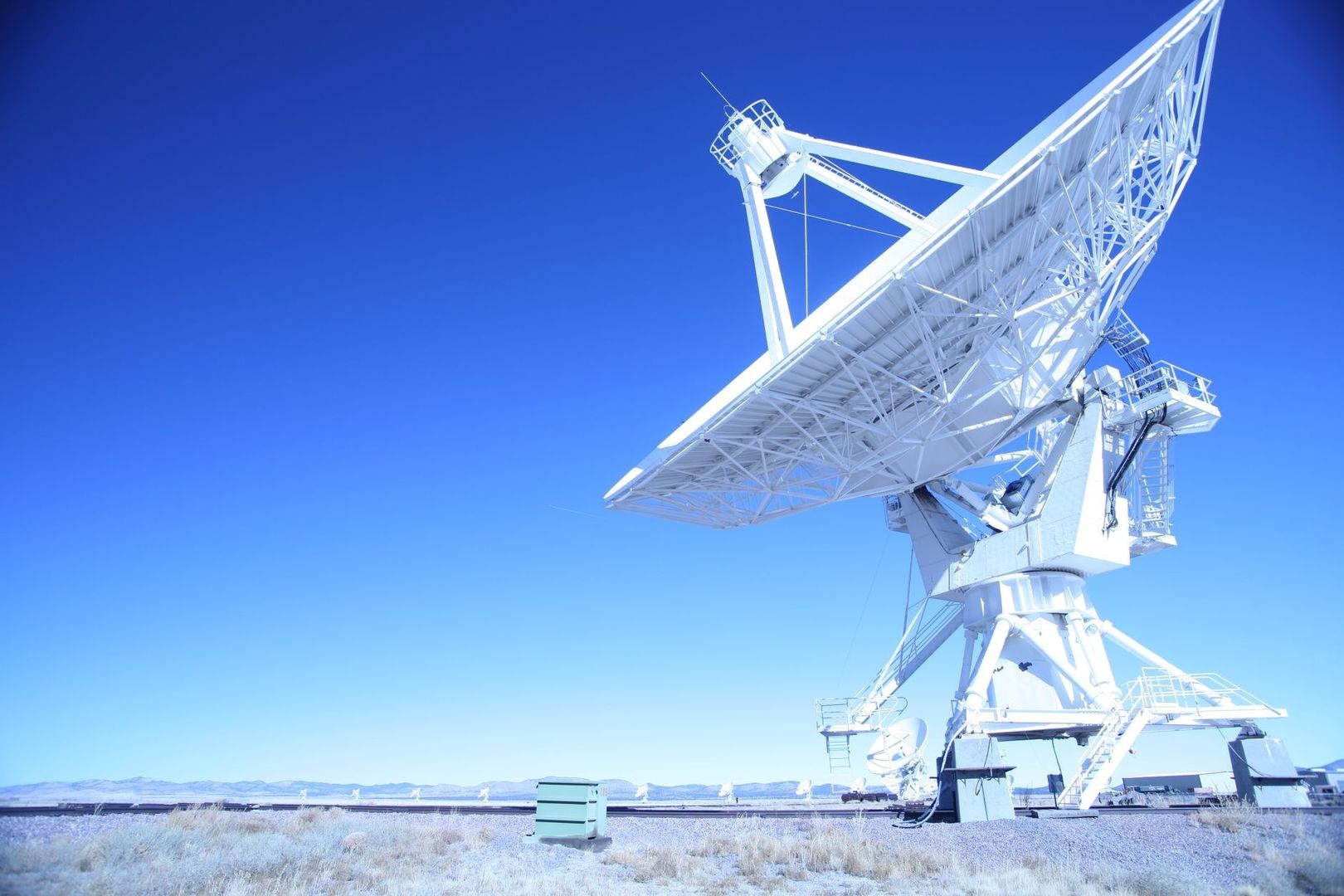
Distributed ground-array research illustrates the engineering direction. Rather than relying exclusively on a large mechanically steered dish, multiple smaller arrays can be coherently combined to improve capacity, tracking flexibility, and interference management. The trade-off is that coherent combination requires accurate phase calibration, timing distribution, synchronization, and beam-management software. The technical background is discussed in research on distributed satellite ground stations, which addresses the challenge of scaling ground infrastructure as LEO deployments expand.
Optical inter-satellite links, by contrast, use extremely narrow laser beams. Their small divergence supports substantial spatial reuse and reduces the probability of unintended interference, but it makes pointing, acquisition, and tracking a first-order system function. Optical terminals must establish a pointing solution, acquire the remote terminal, close tracking loops, and maintain alignment despite structural disturbance, thermal distortion, and ephemeris uncertainty. Once locked, an optical link can provide very high throughput with low electromagnetic interference and strong resistance to RF congestion. It is also largely unaffected by atmospheric attenuation when used between spacecraft, although atmospheric effects return at optical ground terminals.
| Characteristic | RF phased array | Optical inter-satellite link |
|---|---|---|
| Beam divergence | Relatively wide, depending on aperture and frequency | Very narrow, commonly requiring sub-milliradian pointing performance |
| Acquisition | Generally tolerant of larger pointing errors | Requires precise pointing, acquisition, and tracking |
| Data capacity | High and adaptable, but constrained by spectrum and interference | Very high spatial bandwidth with strong frequency reuse |
| Atmospheric susceptibility | RF propagation is affected by rain and atmospheric loss at higher bands | Space-to-space operation avoids atmosphere, while optical ground links remain weather-sensitive |
| Implementation burden | RF chains, calibration, power amplification, and thermal management | Precision optics, fine steering, acquisition sensors, and vibration control |
The practical architecture is often hybrid rather than exclusive. A lower-band or RF control plane can distribute state vectors, handshaking information, and link-management commands while optical terminals carry bulk telemetry and payload data. This approach separates the need for persistent reachability from the need for high-capacity transfer. A relay-assisted architecture described in research on orchestrating optical links with persistent L-band relays follows this principle. At the system level, the control plane reduces the risk that a narrow optical beam becomes operationally stranded during an unscheduled event.
Real-Time FPGA Doppler Shift Compensation and Carrier Recovery
Doppler compensation is a continuous control problem, not a one-time frequency offset correction. During a typical pass, the received carrier follows a smooth S-curve, with the sign and slope changing as the spacecraft approaches, reaches closest approach, and recedes. The exact rate depends on orbital geometry, elevation, carrier frequency, and relative motion. At higher RF bands, even modest radial velocity produces larger absolute frequency errors, and rapidly changing slopes can challenge acquisition and tracking loops. A predictive estimate from orbital state vectors should provide the coarse correction, while the receiver must close the residual error loop against measured signal phase and frequency. The practical implementation of carrier tracking across varying satellite passes is demonstrated in research on multi-constellation software-defined receivers for LEO Doppler tracking, which highlights how multi-satellite frequency discrimination and Doppler extraction algorithms operate over rapid orbital trajectories.
Radiation-hardened FPGAs are well suited to this task because they can execute deterministic, parallel DSP pipelines with bounded latency. A numerically controlled oscillator generates the compensating complex sinusoid, while a carrier recovery loop estimates residual phase and frequency. A Costas loop is a common choice for suppressed-carrier modulation because it can recover carrier phase without requiring a separate pilot in every implementation. Loop bandwidth must be selected carefully: a narrow loop filters noise but may not track rapid dynamics, while a wide loop follows Doppler more readily but admits additional phase noise and can reduce stability margins.
High-order modulation increases spectral efficiency but tightens the error budget. Frequency error, phase jitter, timing drift, and amplitude imbalance can combine to move samples across decision boundaries. Constant-envelope CPFSK is attractive in spacecraft transmitters because it allows the power amplifier to operate near its 1 dB compression point without the linearity burden associated with high peak-to-average waveforms. Research on multi-h CPFSK shows that changing modulation indices can provide coding gain, but the receiver must select the correct matched-filter and Viterbi-decoder state while maintaining symbol timing.
- Use ephemeris-based feed-forward correction to remove most of the expected Doppler before carrier-loop processing.
- Implement NCO resolution and update rates that prevent quantization spurs from becoming significant relative to the residual carrier error budget.
- Size carrier and timing loops against the worst expected Doppler slope, not only the average pass profile.
- Protect Viterbi and timing-state logic against errors exceeding one symbol period, which can cause catastrophic loss of lock.
- Validate phase-noise, clock-jitter, and fixed-point effects together because independent margins can disappear when impairments combine.
For CPFSK receivers, timing recovery deserves the same design attention as carrier recovery. If a decoder’s time estimate slips beyond one symbol, it can select the wrong modulation index and calculate path metrics with inappropriate filters. Practical corrective methods include inserting dummy metrics so the timing reference can change smoothly or running parallel decoders with different transition assumptions and selecting the strongest metric outcome. These techniques illustrate a broader rule for FPGA telemetry designs: recovery logic must be designed for graceful state correction, not only nominal lock.
Dynamic Telemetry Scheduling and Deterministic Orbital Handoffs
Keplerian motion makes many future contacts predictable. A time-expanded graph represents satellites and links as time-indexed nodes and edges, allowing the scheduler to determine when a route exists, how long it remains available, and what capacity is reserved. Contact Graph Routing applies a related idea by forwarding bundles according to predicted contacts rather than assuming an always-connected network. This is valuable for LEO systems because the scheduler can distinguish a temporarily unavailable link from a failed link and can plan around both visibility windows and expected handoffs.
Deterministic scheduling also supports frequency coordination and interference control. Non-geostationary systems must coordinate spectrum use internationally because transmissions cross national boundaries and can affect other networks. The ITU process includes system filings, compliance checks, publication, identification of potentially affected systems, and detailed coordination before regulatory recognition. Operational schedulers must therefore align not only with spacecraft geometry but also with approved frequency, power, and interference constraints.
- Distribute authenticated ephemeris, clock, terminal-status, and predicted-contact data to every routing participant.
- Construct a time-expanded contact plan covering inter-plane and intra-plane optical opportunities, RF fallback paths, gateway visibility, and reserved command windows.
- Pre-stage pointing profiles, acquisition parameters, modulation settings, and encryption context before the predicted contact begins.
- Establish the successor link while the current path remains active, then perform sequence-number and buffer-state synchronization.
- Switch forwarding responsibility only after the successor confirms readiness, preserving in-flight packets through duplication, buffering, or controlled forwarding overlap.
- Release the old contact and update the graph using measured acquisition time, residual capacity, link quality, and spacecraft health.
The handoff policy should distinguish traffic classes. Mission-critical command and telemetry require bounded latency, high integrity, and protected capacity even when payload routing is consuming most of the optical bandwidth. Payload data can tolerate delay or rerouting if it is buffered and prioritized correctly. A useful implementation assigns hard reservations for command, health, and fault-reporting traffic, then allocates remaining capacity through weighted scheduling. This prevents a sudden imaging campaign or sensor burst from starving the very telemetry needed to manage the spacecraft.
A hybrid control plane can reduce the risk associated with optical acquisition delay. An always-available RF relay or neighboring RF path can carry state vectors and link-control messages while the optical terminal completes pointing and tracking. The Space Development Agency’s Transport architecture publicly emphasizes resilient low-latency networking, optical inter-satellite links, dynamic handoffs, adaptive modulation, automated routing, and communications security. The underlying systems principle is straightforward: route selection, link acquisition, and resource reservation must be coordinated as one deterministic transaction, rather than treated as independent subsystems.
Security design should follow the same systems perspective. When evaluating edge-computing architectures and message integrity across embedded radios, resilient security frameworks for mission-critical networks emphasize authentication, availability, and fault containment. The specific threat model differs in orbit, but the design lesson transfers: safety-critical messages require explicit trust boundaries, authenticated state transitions, and recovery behavior that remains safe when links are intermittent.
Securing COTS Architectures and Mitigating Hardware Vulnerabilities
Commercial off-the-shelf components can reduce cost, improve availability, and accelerate development, but they also expand the attack surface. Auxiliary devices such as interface controllers, sensors, power-management units, debug components, and communication bridges may receive less security scrutiny than the main flight computer while retaining access to telemetry, shared memory, system calls, or the software bus. A compromised component could exfiltrate telemetry, inject false health data, alter routing state, or create a denial-of-service condition without immediately appearing as a conventional software fault.
The response should combine architectural isolation with runtime verification. A separation kernel can enforce partitions between flight functions, payload processing, communications management, and security services. Zero-trust telemetry means every message is authenticated and authorized according to sender, function, freshness, and permitted destination. Hardware-enforced secure enclaves can protect key material and verify critical code paths, while memory-protection units, immutable boot roots, and restricted debug access limit lateral movement across cross-links.
- Authenticate software-bus messages and apply access control at publishers, subscribers, and gateways.
- Use secure boot and measured boot to detect unauthorized changes before enabling cross-link services.
- Monitor system-call patterns, message rates, reset behavior, and unexpected telemetry access at runtime.
- Apply least-privilege permissions to COTS modules, including components that appear operationally auxiliary.
- Maintain supply-chain records, firmware provenance, component configuration baselines, and controlled update procedures.
These controls must be sized for radiation, power, and compute limitations. Cryptographic verification should be hardware-assisted where practical, but key management, replay protection, and failure recovery remain system responsibilities. The goal is not to make every spacecraft function impossible to interrupt. It is to ensure that a compromised payload processor cannot inject commands into the flight bus or pivot through an optical cross-link into neighboring spacecraft.
Building Resilient Autonomous Mesh Backhauls in Low Earth Orbit
Reliable LEO telemetry emerges from the convergence of three engineering layers. Optical cross-links supply high-capacity, low-interference paths; FPGA DSP maintains carrier, timing, and modulation integrity under rapidly changing Doppler; and deterministic graph scheduling turns predictable orbital motion into a usable transport plan. None of these layers is sufficient alone. A high-rate optical terminal is ineffective if acquisition is not scheduled, a precise carrier loop cannot compensate for an unavailable route, and a contact graph cannot deliver telemetry if the physical layer loses lock during a handoff.
Next-generation constellations will increasingly automate ephemeris distribution, link-state measurement, contact-plan generation, and onboard route selection. AI-assisted routing may help rank alternative paths using predicted congestion, terminal health, weather at optical gateways, and historical acquisition performance, but it should operate within deterministic safety boundaries. For aerospace architects, the key design priorities are explicit timing budgets, verified handoff states, protected telemetry capacity, radiation-tolerant DSP implementation, and hardware-enforced security domains. A resilient orbital fabric is built when those decisions are made together, from the antenna aperture and FPGA data path through the routing algorithm and trust model.